Introducing: Beam Preview Environments
 John Marshall
It can be annoying to develop applications in the cloud. You need to manage instances, container images, and security groups. Those things need to be exposed to the internet. CI needs to be set up. Rollback and auto-scaling strategies need to be configured. There are lots of hoops to jump through.
It’s especially difficult if you’re developing applications on a GPU. Now, you’re also forced to deal with big libraries, CUDA versions, and 10Gi images that need to get pushed to image registries.
Our Mission
At Beam, we’re building a serverless experience that removes these obstacles from your development workflow.
We envision a future where ML applications can be containerized instantly, pushed to the cloud, and scaled automatically, without the developer having to run Docker or setup Kubernetes.
Our main product is a system that allows users to run REST APIs, task queues, and scheduled jobs – all with just a few lines of code.
But if you’ve ever developed a serverless application, you know that a good local development workflow is critical for staying productive.
Serverless Debugging on Beam: A Short History
In our initial version of Beam, we shipped a feature that let you develop in a shell, which was connected to a remote container on Beam.
We did this by spinning up a websocket connection and mounting your local workspace to a remote container that was similar to the one you’d run in production. This made it possible to test your applications on the exact environment you’d be deploying in.
This workflow was great for iteratively developing in a production environment. But it didn’t truly offer an end-to-end testing experiment. Many of you told us that you wanted a way to mimic the exact functionality of your apps in production. For example, if an API call in production returned a Task ID, you wanted to replicate that behavior during your testing.
Introducing Beam Serve
Today, we’re releasing Beam Serve. It allows you to serve functions in the cloud without a persistent deployment.
It functions sort of like an Ngrok server that live-reloads as you work. Beam monitors changes in your local file system and forwards the remote container logs to your local shell.
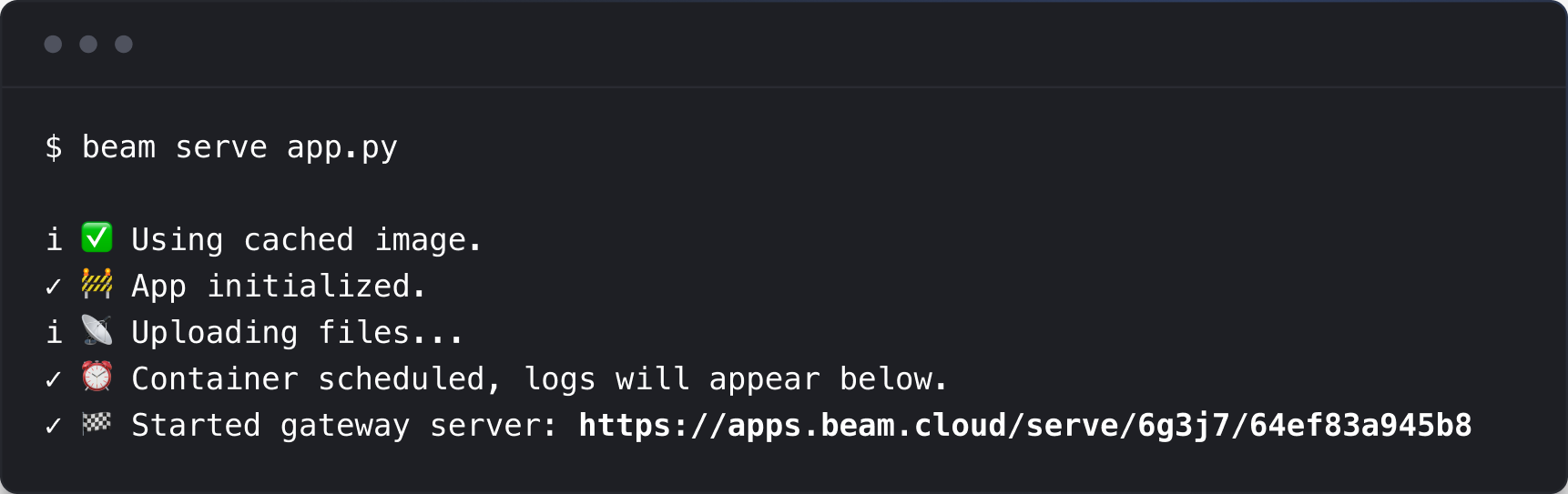
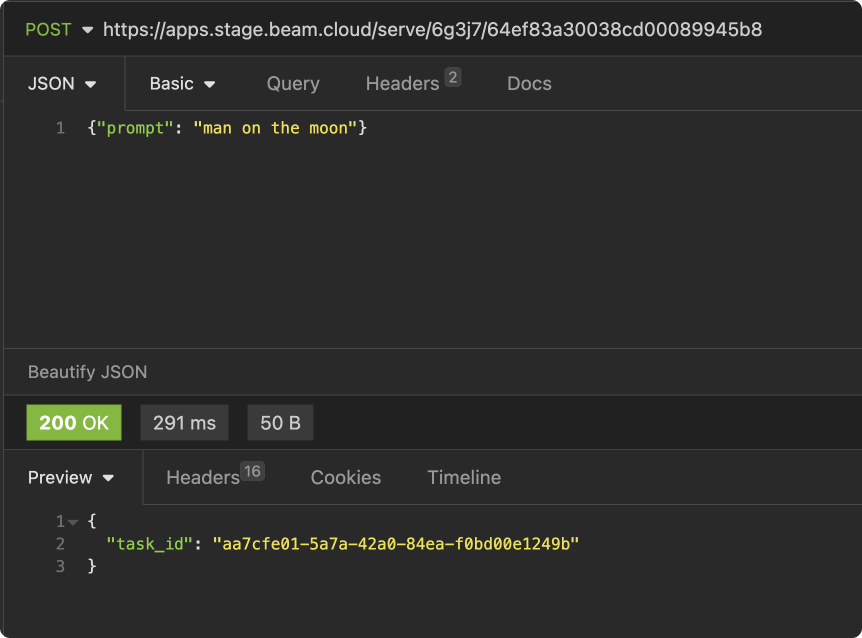
You can also launch serve without hot-reloading, and just leave an endpoint running in the background. For example, let’s say you wanted to share a stable diffusion app, but only wanted to share it with your co-workers for a day. Serve is perfect for that.
Closing
With Beam Serve, we're making it even easier to run ephemeral functions on the cloud. If you have any feedback, reach out -- we'd love to hear from you.